A fitted kitchen without the line “price depends on the site visit”.
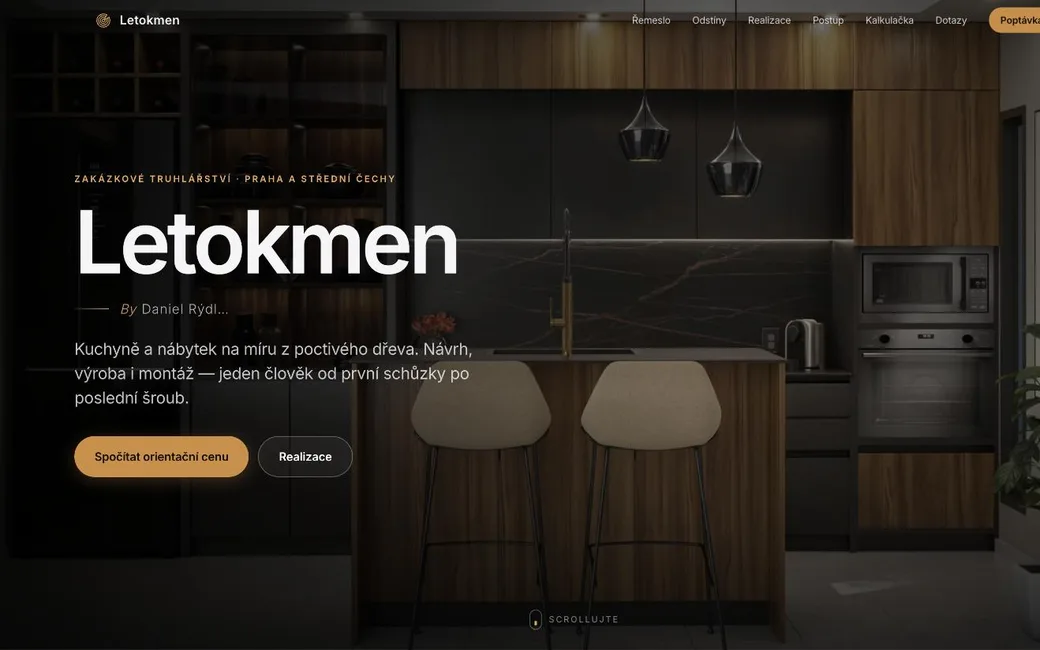
Bespoke joinery for Prague and Central Bohemia. One person from the first meeting to the last screw — and a website that can name a price before he drives out to you.
A case study of a website for a joinery: Letokmen is Daniel Rýdl’s bespoke workshop — fitted kitchens, built-in wardrobes, solid-wood tables, bathroom furniture, doors and staircases for Prague and Central Bohemia. We built the site as a one-page presentation with a kitchen price calculator for six types of job and an enquiry form.
With bespoke furniture the first question is always about price, and the answer is “it depends on the site visit”. Meanwhile the customer opens a shop selling a ready-made kitchen in the next tab and has nothing to compare it with. A joiner cannot promise a fixed price from his desk — but if he says nothing, he gives the visitor no reason to go on. And because this is a workshop that is only just starting up, there are no photos of finished work and no references either: the site has to convince without both.
02
How we solved it
We built one page with the calculator at its centre. The customer picks one of six types of job, moves a few sliders — the length of the run, the door material, the worktop, the fittings, the appliances — and sees an indicative amount. Right next to it, it says this is not a quote but an estimate you can plan with. The rest of the page answers what comes immediately after: where the difference between cheap and honest work shows, how the work goes in five steps, and eight questions on which a job most often turns.
The path from visit to enquiry
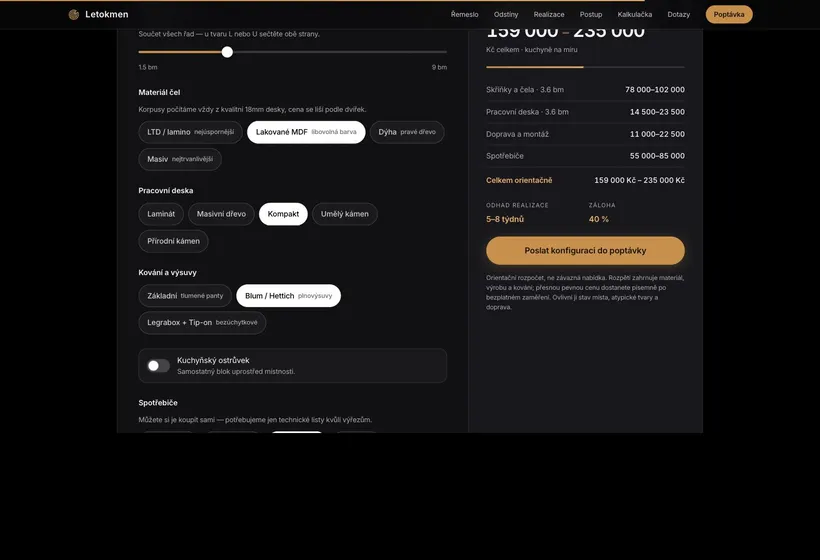
Calculator: the length of the run, the door material, the worktop, the fittings and the appliances — a result of CZK 159,000 to 235,000, an estimated 5–8 weeks to complete, a 40% deposit. It is not a quote: the calculator combines the type of job, the dimensions and the materials into an indicative range; the exact price comes only after a free site visit.1In the calculator, the customer works out an indicative price for their job — without entering any contact details.
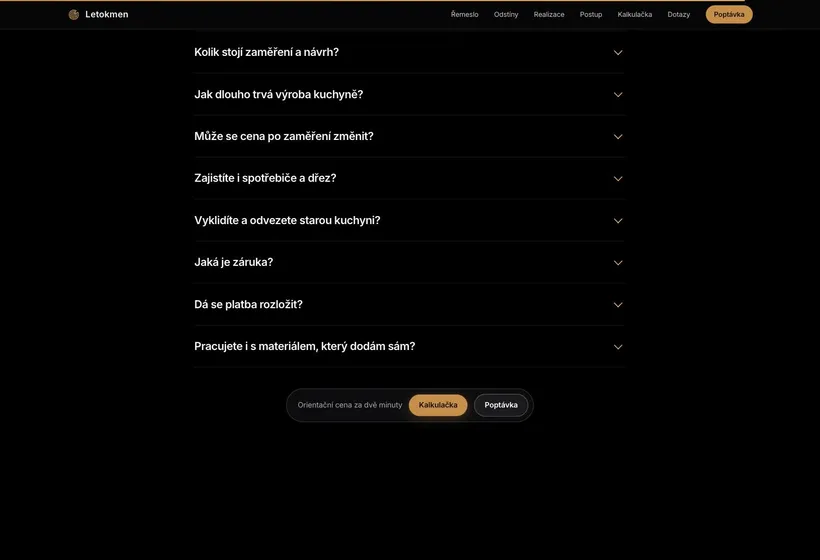
FAQ: eight questions, from the cost of the site visit through the guarantee to spreading the payment.2They go through the five steps of the work and eight questions they would otherwise only settle on the phone.
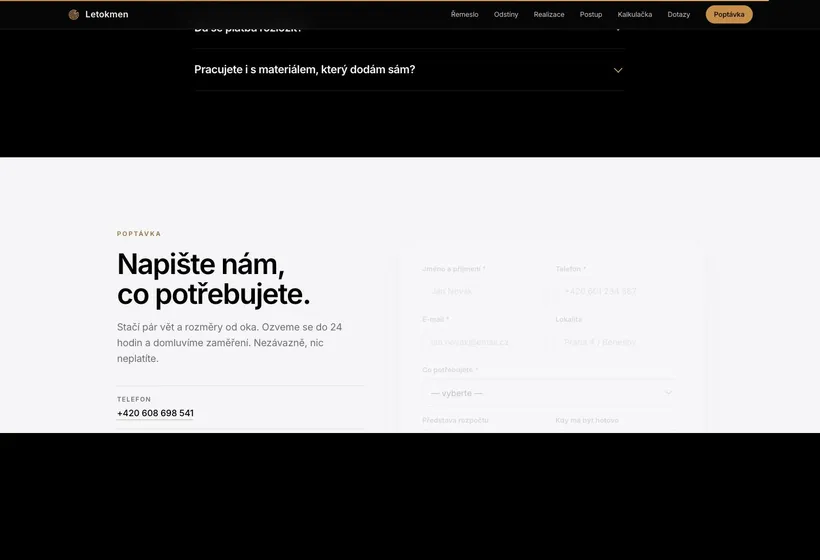
Enquiry: name, phone, e-mail, location, what you need, a rough budget and a date.3They send an enquiry with rough dimensions. Within 24 hours the joiner gets in touch and arranges the site visit.
The screenshots are from the live site, taken on 12 September 2026.
A studio decision
Building the whole page around the calculator was our decision, not the client’s brief. It meant putting a price out there before the joiner takes a contact — and carrying the responsibility when the estimate does not match reality after the site visit.
What exactly we delivered: We delivered the design and copy for the whole page, a calculator for six types of job, a gallery of finished work, a section on the process, an FAQ, an enquiry form with e-mail integration, deployment and domain setup. The project therefore covered UX design, copywriting, a price calculator and the implementation of a one-page website for a bespoke joinery in Prague and the Central Bohemian region.
Verifiable outputs
What can be verified without inventing figures
These are not conversion metrics. They are the parameters of that page — open it and check our arithmetic.
6job scenarios covered by the calculator
0contact details needed before the estimate appears
5steps explained before an enquiry is sent
8obstacles answered directly on the page
The figures describe the structure of the site as of 12 September 2026 and can be verified on it. We put the ranges in the calculator together from publicly available price lists of bespoke joineries and from materials the workshop gave us; we do not publish its own costings, and the page states that the rates are market prices for 2026. We have no data on the client’s revenue or number of enquiries, so we do not pass any off as a result of the project.
What we built
Key features and elements
A calculator for six types of job
Kitchens, wardrobes, tables, bathrooms, doors and staircases. For a kitchen it counts the length of the run, the door material, the worktop, the fittings, an island and the appliances. The customer does not have to leave contact details to see the result.
A price that promises nothing
Next to the result it says this is an estimate, not a quote, and that it may change after the site visit. A calculator promising a fixed price would do more harm than good — the first meeting would then start with an apology.
The process in five steps
Enquiry, site visit and design, approval and deposit, production in the workshop, fitting and handover. Someone buying bespoke furniture for the first time therefore knows what they are getting into and when payments fall due.
Eight questions on which it turns
What the site visit costs, how long production takes, what happens to the price after the visit, what the guarantee is, whether the payment can be spread. Answered before anyone has to ask them.
A new company, no portfolio — and how to deal with it
Letokmen is a newly founded workshop — as yet it has no photos of finished work and not a single reference. This is exactly the situation people come to us in most often. So the gallery shows illustrative images, and the client-testimonials section is ready in the code but switched off; it can be switched on without rebuilding the site as soon as there is something to show.
A “What our clients say” section with invented names would harm a new company more than an empty space. Here, instead of references, trust is carried by things that can be verified straight away: a price worked out without entering contact details, five steps of the process and eight answered questions.
What we would add next: the option of e-mailing the calculated estimate to yourself. Today the result lives only in the browser.
What your company can take from this
When you do work where the price really does depend on a site visit, the answer is not to keep the price quiet. It is to give people a range and, right beside it, write why it is an estimate. It filters out the customers you would never have agreed terms with anyway, and it saves everyone else one phone call in the decision.
A website for a tradesman then differs not by trade but by how it handles price — it works the same for building firms, landscaping, removals, repair shops and installers.
Where, by contrast, it does not make sense: on jobs where the price varies by orders of magnitude with the brief — building a house, larger renovations, custom development. There a calculator either spits out a range so wide it helps nobody, or it necessarily lies. For those industries it makes more sense to describe what the price is made up of and what moves it most. What a website like that costs you will find in the price overview, and you can work out an indicative price for your own site in our calculator.
Frequently asked questions
What you most often ask about this
Is it worth putting a price on the website when it depends on a site visit?
Yes, as long as it clearly says it is an estimate. Without any idea of the price, people decide worse — and they leave for wherever they did get an answer. You do not have to promise a fixed price — a range and a sentence about what moves it is enough. What a site with a calculator costs →
What should a price calculator on a tradesman’s website do?
Work out an indicative price from figures the customer knows by heart or can measure roughly, and say clearly that it is not a quote. It should also show what moves the price most: on Letokmen you can see it on the worktop — laminate comes to CZK 1,500 to 2,500 per running metre, compact to 4,000 to 6,500 and natural stone to 9,000 to 16,000. One switch therefore does more to the final figure than the length of the whole run. A more complicated calculator puts people off before they finish it.
I am starting a company and have no references or photos. Can a website be made now?
Yes, and it is the most common starting point people come to us with. The section is prepared and left hidden until you have something to show — invented references or someone else’s photos passed off as your own do more damage. The site is then simply added to; it does not have to be made again. What to prepare before building a website →
Write a few sentences about what you do and what your price is made up of. Within 24 hours we will answer whether a calculator, a price range or another way of handling price suits your service — and send an indicative scope, a price and the earliest possible date, along with two or three concrete examples of how price can be shown in your industry.