A brewery’s entire price list on one page. Three clicks to an order.
Keg and bottled beer delivered across Prague. Dozens of items, an age gate and a customer who mainly wants to know quickly whether the keg will arrive before the weekend.
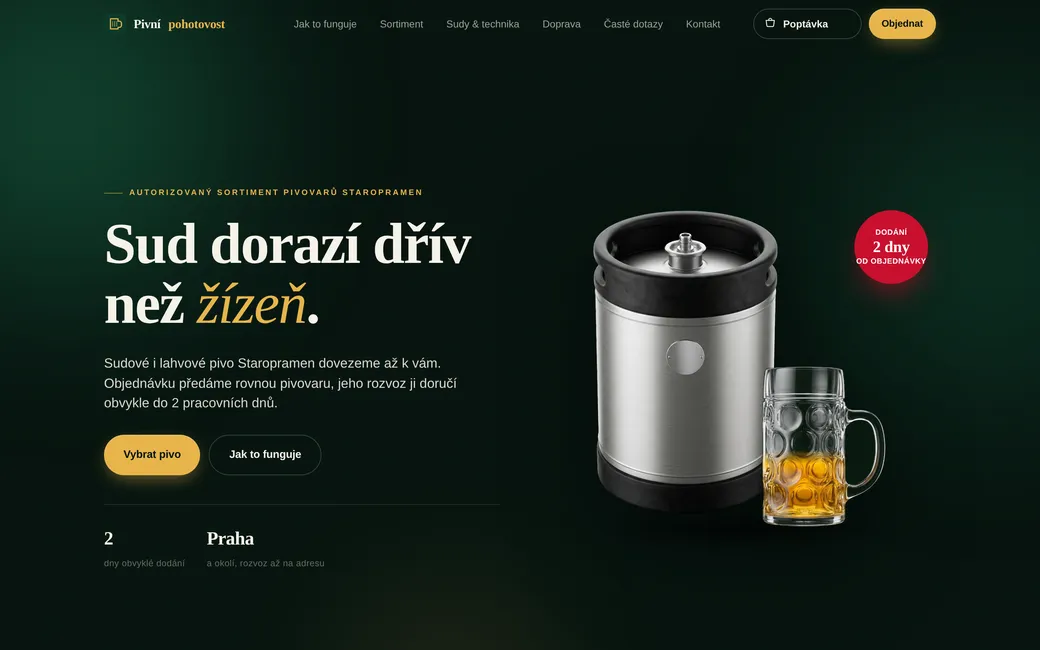
Pivní pohotovost delivers Staropramen keg and bottled beer across Prague and the surrounding area. We designed the site as a one-page catalogue of 67 items with a basket and ordering — without a conventional e-shop.
A brewery’s range is not five items. It is kegs in several sizes, bottles, cans and, on top of that, tap equipment hire — dozens of price-list rows in total, which the customer is supposed to make sense of on a phone, usually at the last minute. A conventional e-shop with a payment gateway, stock management and customer accounts would have made the launch more expensive and months slower. And because it is alcohol, the site also has to handle age verification.
02
How we solved it
We built one page that handles the role of both price list and ordering system. The whole range is in a catalogue with filters and search, and every item has a price per pack including VAT. An order ends with a form and payment on delivery, not a payment gateway — for a business that calls back about the delivery date anyway, that is a cheaper and faster route to launch. The age gate is the first thing a visitor sees.
The path to an order — those three clicks
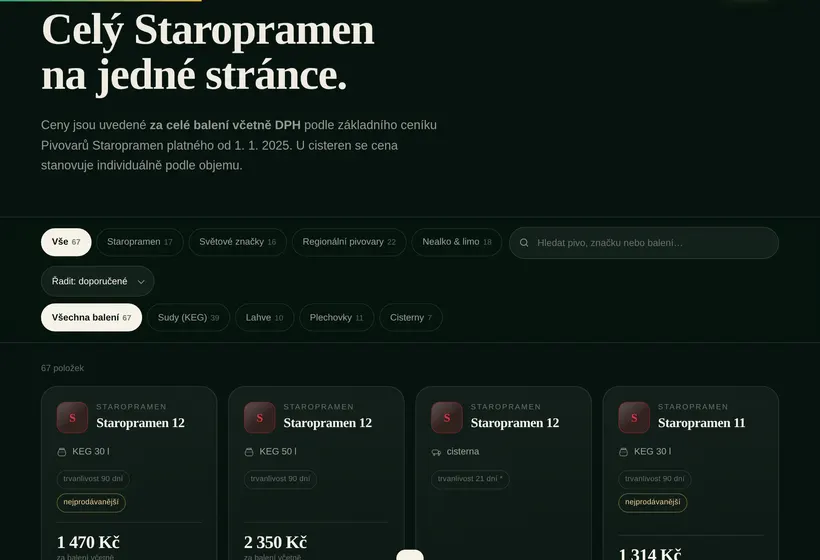
Catalogue: 67 items, filters for KEG barrels / Bottles / Cans / Tankers, a search field.1The customer finds a keg or a pack in the catalogue (with a filter, or simply by typing what they are looking for).
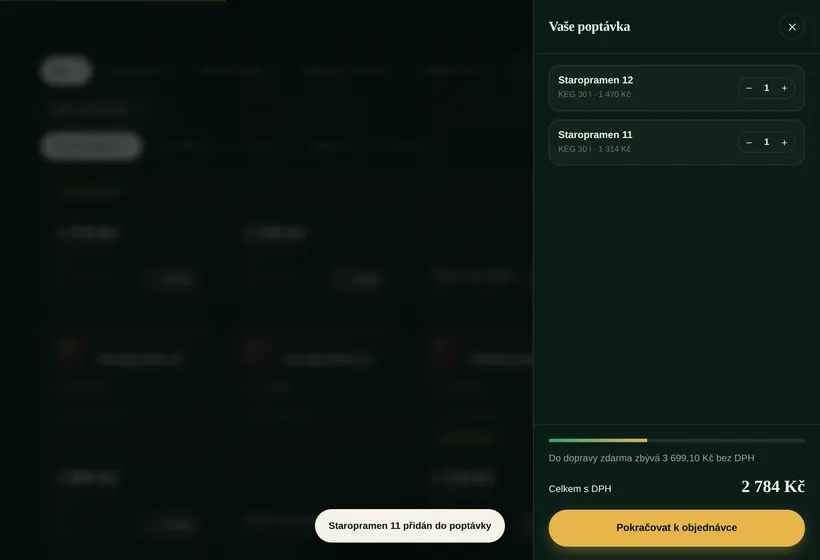
Basket: two items, a summary and a total of CZK 2,784 including VAT.2They add it to the basket and immediately see the total including VAT.
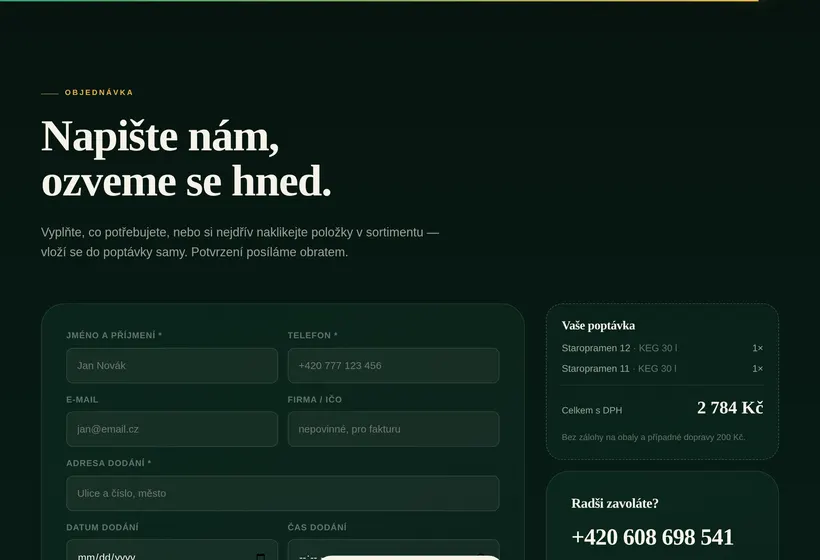
Form: a summary of the order with the same amount, the date and the delivery address.3They send the order with a date and an address. The operator then only has to confirm availability.
The screenshots are from the live site. By three clicks we mean the three main steps of the ordering flow, from finding an item to sending the order. We do not count filtering and search in that.
What exactly we delivered: The page design, the catalogue with filters and search, the basket and order form, the age gate, structured data for all 67 items, image optimisation, deployment and performance measurement.
Measurable results
What can be verified
67items in the catalogue
3clicks to send an order
90Lighthouse Performance, mobile
CZK 0a month for an e-shop platform and gateway
The number of items comes from the site’s catalogue. We measured Lighthouse Performance on 12 September 2026 on that page’s code (mobile profile with a simulated slower connection); on desktop it comes out at 99. It is a laboratory speed score, not proof of a business result. The whole page including images weighed 350 kB in that measurement, so it loads even on mobile data. “CZK 0 a month” means the business pays no fees to an e-shop platform or a payment gateway — hosting and site maintenance are paid separately. We do not yet measure how many orders the site has brought in — when we do, we will add it here.
What we built
Key features and elements
A catalogue with filters and search
Kegs, bottles, cans and tap equipment in one place. The customer filters by type and size or simply types what they are looking for. Prices are per pack and include VAT — no “price on request”.
Basket and order summary
Items add up in the basket and the customer sees the total before sending the enquiry. The order arrives with a date and an address, so the first phone call is only about confirmation.
Age gate
The site asks about age before it shows anything. An obligation with alcohol that can be done so that it does not get in the way — one click, and the page remembers the answer.
Structured data for the whole range
Every item is also described in machine-readable form, including price and availability. Search engines and AI assistants can therefore read the content more easily and offer it to someone asking in their own words. It is no guarantee of placement — but without structured data they have nothing to go on.
What the site does not have yet
It is not a full e-shop. There is no payment gateway and no stock integration — payment is on delivery and the operator keeps an eye on availability. For a business that calls back about the delivery date with every order anyway, that makes sense and saves not only money at the start but the monthly fees too.
If orders grew to the point where the phone calls became unmanageable, a payment gateway can be added — the page is built for it. We ourselves do not recommend it before it starts to be needed.
What your company can take from this
Having an extensive price list does not automatically mean an e-shop. The difference between “a catalogue with an order form” and “an e-shop with a payment gateway and stock management” is tens of thousands of crowns and weeks of work. Plenty of small businesses get by with the first — and can add the second later, once the volume makes it pay for itself. The same principle works outside beer: a menu with ordering, a tradesman’s price list, a service offer with variants or a spare-parts catalogue.
We will build you either. We will tell you straight which makes sense for you, even if it means a smaller job for us. Prices are in the price overview, and we go through the differences in the article on e-shop development.
Frequently asked questions
What you most often ask about this
Do I need an e-shop, or is a catalogue with ordering enough?
If you call back about the date or availability with every order anyway, a catalogue with an order form is usually enough and considerably cheaper. A payment gateway, stock management and customer accounts start to make sense at the volume where confirming by hand becomes unmanageable. We go through the differences in the article on e-shop development →
How do you handle selling alcohol on a website?
With an age gate that appears before the content, and clearly stated terms of sale. On the Pivní pohotovost site it is one click and the page remembers the answer, so it does not hold the customer up on their next visit.
What if I find later that I need a full e-shop?
You do not have to build it straight away. The page is built so that a payment gateway, stock management and further automation can be added later — once the order volume makes it pay for itself. Until then you are not paying monthly fees for something you will not use. What a website and an e-shop cost →
Got a price list your customers get lost in on mobile?
Describe your range in a few sentences and tell us how you take orders today. Within 24 hours we will propose the simplest solution, a price and a date — even if it turns out you do not need a full e-shop.